Man Ray, Cœur à barbe, Spazio Morgagni. Works from Galleria Gió Marconi.
The Cœur à barbe exhibition was hosted at Spazio Morgagni from 20 to 30 April 2026. Man Ray is removed from the monumental scale of the museum and returned to an almost domestic setting, characterised by movement, detail and proximity. The selection of multiples, photographs, lithographs, films and artists' books from Galleria Gió Marconi achieves something unusual: rather than leaving visitors with the impression of having seen an exhibition about Man Ray, it gives them the feeling of
having moved through a system of relationships in which images continue to shift even after the visit, revealing a surprising contemporary relevance. The title recalls the historical episode that marked the tensions between Dada and Surrealism; here, however, that rupture translates into a spatial question: how can we inhabit an image without confining it to a definitive meaning? Spazio Morgagni, formerly Gino Barbiere, has a tangible memory that makes it impossible to separate the works from the space in which they are displayed.
Upon entering, one immediately experiences a sense of proximity. There is no protective distance between viewer and artwork; the exhibition invites visitors to move, pause and continually reconsider their point of view. In this context, works such as Autoportrait avec moitié barbe, Cadeau and À l’heure de l’observatoire – Les Amoureux cease to appear as canonical images from the Surrealist repertoire, instead becoming presences that alter the perception of the surroundings and shift the rhythm of the gaze
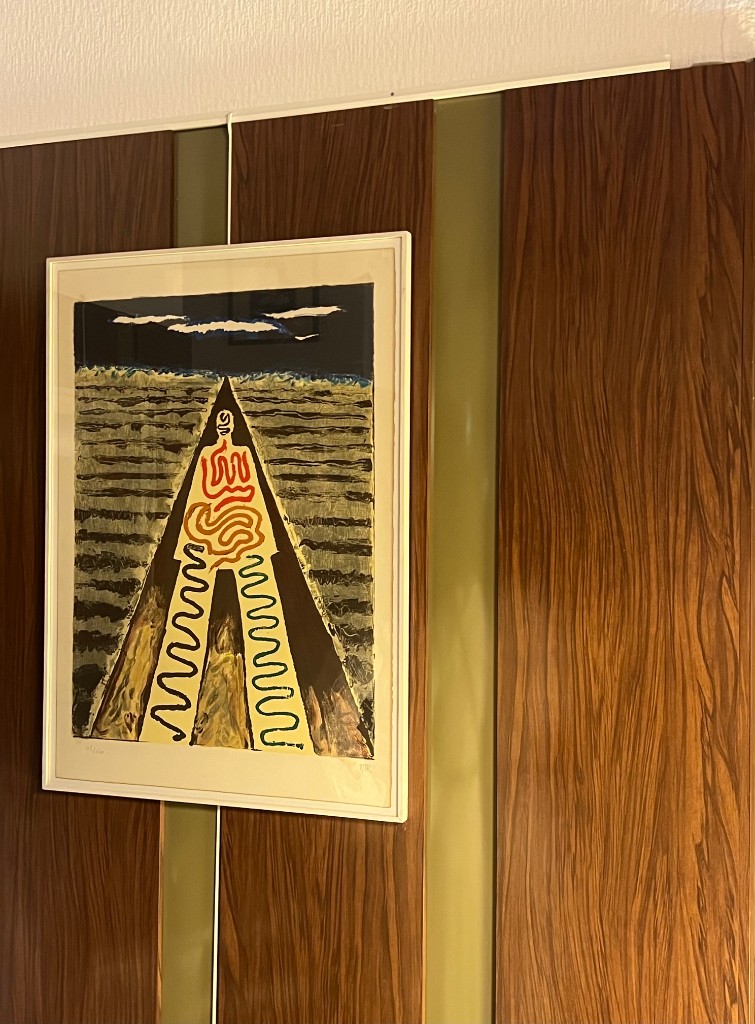
The inclusion of Unité de Saint-Jean-de-Luz, a colour lithograph, is particularly significant as it introduces an unpredictable dimension to Man Ray’s work. Here, colour operates as a form of mental matter, while the gesture retains an immediacy and a sense of unresolvedness.
The work's presence, made possible by Galleria Gió Marconi, also prompts reflection on the role of Italian collecting. In this context, the provenance of artworks is not a secondary detail; rather, it contributes to the definition of a cultural geography shaped by transitions, legacies, and continuities.