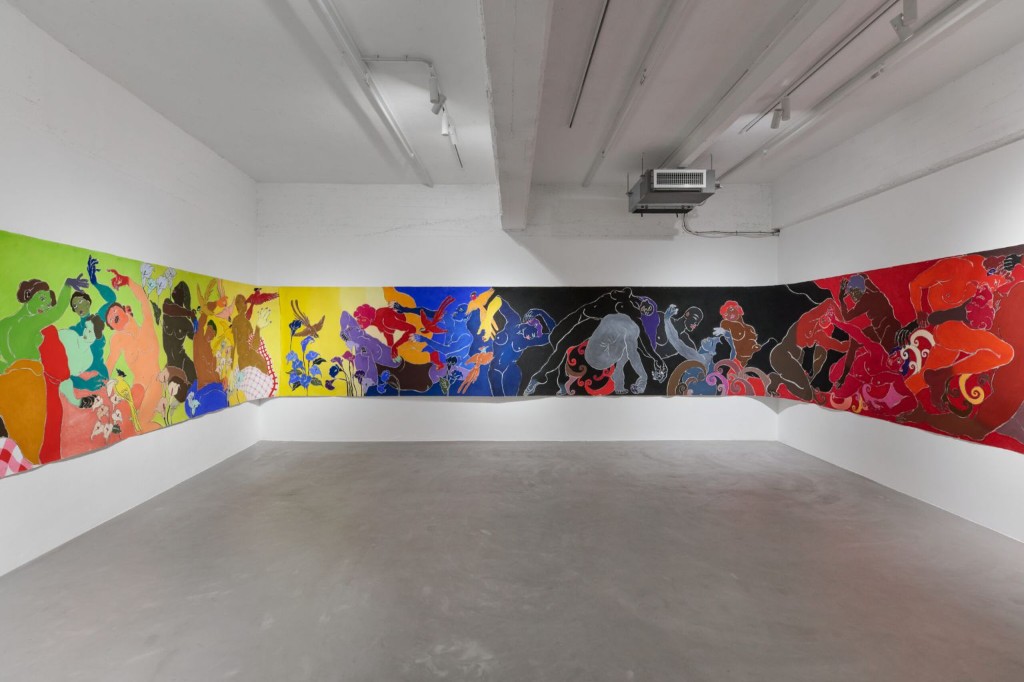
Unfolding as an expanded spatial field and a traversable experience of time, Amparo Viau's Un secreto se apaga entre mis manos reveals itself.
Stepping into the Artnoble Gallery is like entering a dream: Amparo Viau’s dream.
Spanning 40 metres, the artist’s imaginary world immediately captures the viewer’s gaze, drawing them into a dreamlike journey through bodies, colours and emotions, both negative and positive. This is an all-encompassing, almost hypnotic experience, where every detail appears to pulse with life, inviting viewers to slow down and immerse themselves in the work's intricate details. The piece takes on a profoundly performative quality in this way: the bodies seem to come alive and move before our eyes, as though crossing into real space to invade it and fill the room with a vibrant, unsettling presence. Line becomes gesture and colour becomes energy, transforming the entire composition into a kind of visual theatre in constant flux.
Vivid colours and layered symbolism intertwine in a visual narrative that challenges the Western concept of 'good taste'. Rather than rejecting it outright, the artist seems to play with, unsettle and almost mock the notion, before questioning and reshaping it from an alternative, free and untamed perspective. The work does not simply invite observation; it demands to be traversed, challenged, and experienced as a sensory and critical encounter. Rather than presenting itself to the viewer, it invites exploration. The image's extended format precludes simultaneous viewing, imposing a duration that requires time for meaning to emerge progressively.
What we see is always partial and shaped by what we have already experienced or what is yet to emerge. In this continual slippage between presence and memory, drawing loses its stability and becomes an experience. Within this shifting space, the body occupies a central position, though never as a fully formed entity. Viau’s figures never appear as autonomous entities; they intertwine, overlap, and disperse. These are bodies that exist through relationships rather than definitions. Each gesture seems suspended, as though the image captures not so much an action as its potential. The result is a profound ambiguity: the scenes appear on the verge of coalescing into a narrative, yet something continually eludes the constraints of linear storytelling.
This logic is reminiscent of montage, but without a definitive direction. The images do not guide the viewer; they demand attention. They return, become distorted, and are reactivated. Rather than flowing, time accumulates. The installation's structure establishes no hierarchies or points of arrival either. Shifts in density, figurative concentration and colour do not signal progression, but ongoing transformation. There is no before or after, only a series of transitions in which the image seems to reinvent itself each time, as though it could never be definitively fixed.
The work thus presents itself as an environment rather than an image: a continuous trajectory that frees drawing from the logic of frontal composition and simultaneous viewing. Instead, it demands a sequential, situated encounter.
Perhaps this is where the work finds its most incisive form, not in offering new fixed images, but in destabilising the very possibility of recognising them as such.
Unfolding as an expanded spatial field and a traversable experience of time, Amparo Viau's Un secreto se apaga entre mis manos reveals itself.