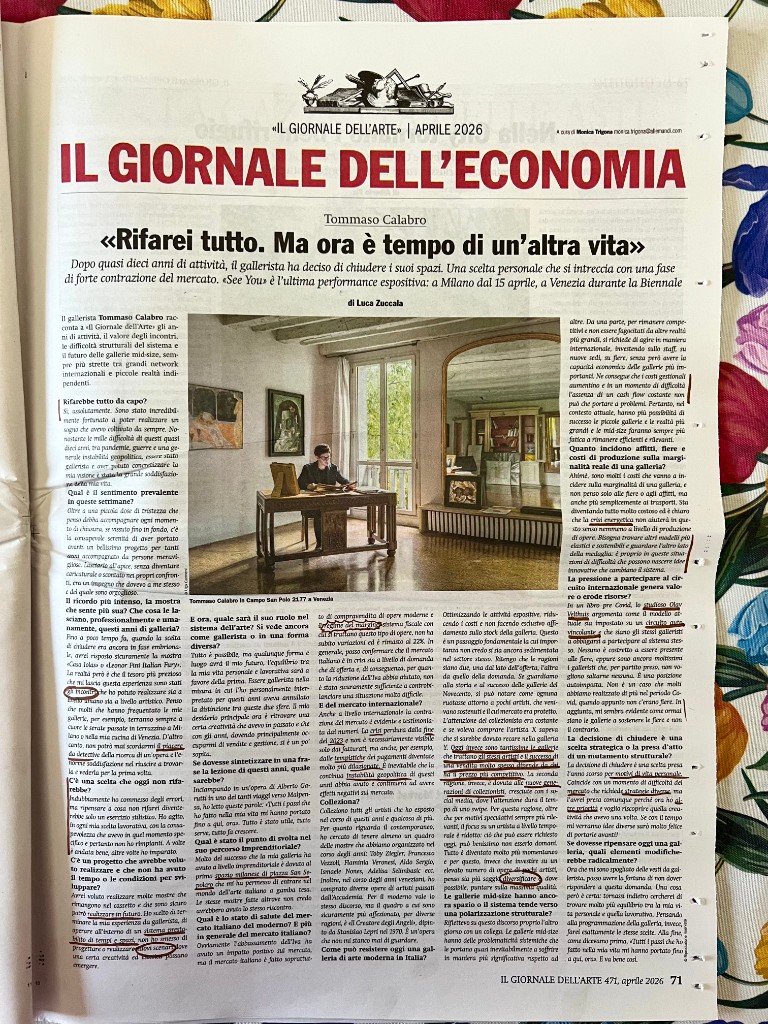
Il Giornale dell’Arte, April 2026. Interview by Luca Zuccala with Tommaso Calabro.
Spring 2026 does not begin with an opening, but with silence. The doors of the Tommaso Calabro galleries in Milan and Venice close almost imperceptibly, leaving behind rooms that have housed artworks, conversations and layers of gazes for years. This is not a dramatic closure, but rather a suspension; the moment when an exhibition ends and the space is left empty, waiting to see what will come next.
For those who have followed the gallery’s trajectory, this development comes as something of a surprise. Yet, upon closer inspection, it appears to be part of a broader narrative. Not only are there the weight of circumstances — the energy crisis, geopolitical tensions and a system struggling to
regain momentum — but also, and above all, a personal, almost intimate choice: to slow down and step away from the relentless logic of production and constant presence for a moment. In his interview with Luca Zuccala for Il Giornale dell’Arte, Calabro conveys a sense of weariness, but also clarity of thought. It is as though, after years of building exhibitions and shaping visions, the time has come to take a step back and observe the bigger picture from a distance. Ultimately, every curatorial practice involves this too: an exercise in perspective and the ability to decide when to fill a space and when to leave it empty.
And so this closure takes on the contours of a narrative gesture. Not an ending, but a pause in the story. An interruption that invites us to reconsider the pace at which stories are constructed and consumed in the art world. The galleries may come to a halt, but the relationships, insights and perspectives they have set in motion continue to circulate in less visible forms yet are no less present.
Perhaps it is precisely in this suspended space that the possibility of a new beginning emerges.
It's not necessarily the same way or in the same places, but it's with a renewed perspective. It's like closing a book halfway through — not to abandon it, but to come back to it later with a different kind of attention.