Where matter becomes thought and a fluid threshold emerges between perception, ecological crisis, and the reinvention of reality.
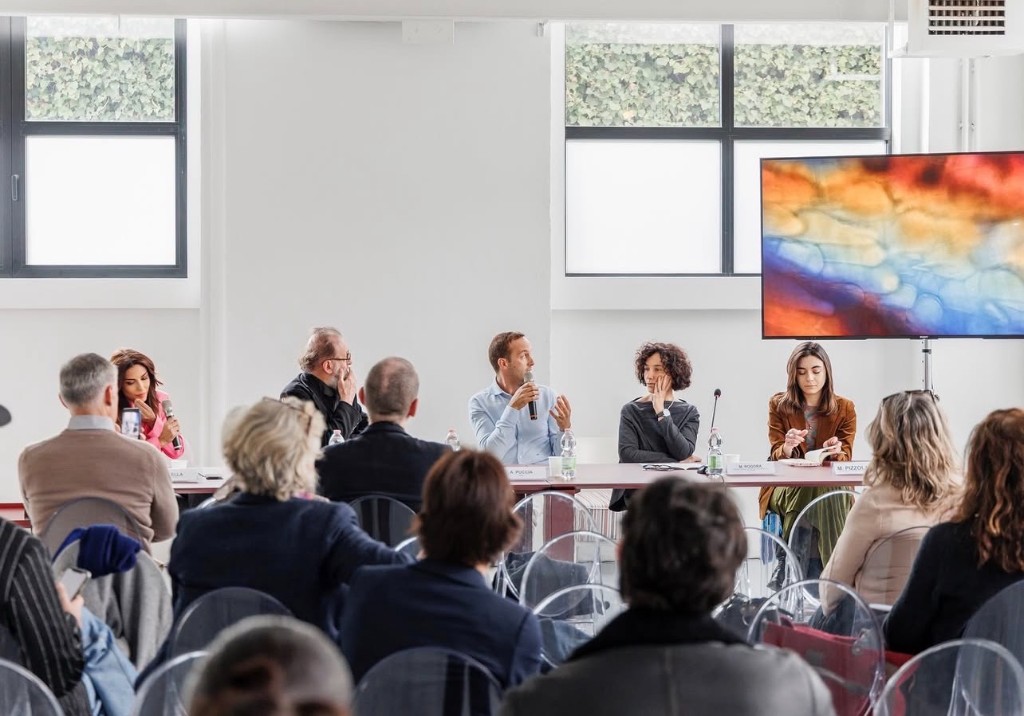
Talk One Drop, MIA Photo Fair. Ph. ZIMA Studio Milan An encounter can emerge from a shared question rather than an explicitly stated theme. This is what happened when Alessandro Puccia, Michele De Lucchi, Michela Rogora and Marta Pizzolante came together in a space for exchange, guided by Clelia Patella. It was not a simple conversation, but rather a movement that unfolded through associations, shifts and resonances. The dialogue takes shape around 'One Drop', a project presented at the fifteenth edition of MIA Photo Fair BNP Paribas in the 'Focus Latino' section, curated by Rischa Paterlini. It unfolds as a journey of exploration rather than a straightforward presentation. As the fair draws to a close on 22 March 2026, the talk takes shape as a curatorial device, weaving together artistic practices, scientific enquiry, and environmental concerns. It approaches water not as a mere theme, but as a conceptual medium through whi ch to interpret the present. Water is a substance that preserves, reflects and transforms, and there is something primordial yet elusive about it. The project, held among other things in conjunction with World Water Day, which was established by the United Nations in 1993, reinforced this critical perspective by situating the discussion within a global context marked by growing water insecurity and inequalities in access to this resource. These challenges now affect regions that were previously considered immune, making it increasingly clear that the water crisis is both material and cultural and therefore requires new policies and new ways of thinking.
In this sense, the talk brought about a significant shift by presenting water as an agent of aesthetics and cognition, capable of shaping perceptual processes and mental states. It
activated the state described by Blue Mind Theory, in which the fluidity, lack of sharp edges, and dynamic nature of water induce a suspension of vigilance and openness to soft fascination. This creates an intermediate space in which thought becomes porous and receptive to mind-wandering, consequently forming new connections. Here, discourse does not merely accompany the artwork; it reactivates it. Each contribution opens up a possible trajectory and each perspective introduces a variation, as though the project were continuing to evolve in the moment of its discussion. One Drop engages with the overarching theme of Metamorphosis at the fair, but takes an understated yet radical approach by beginning with water to explore the concept of change.
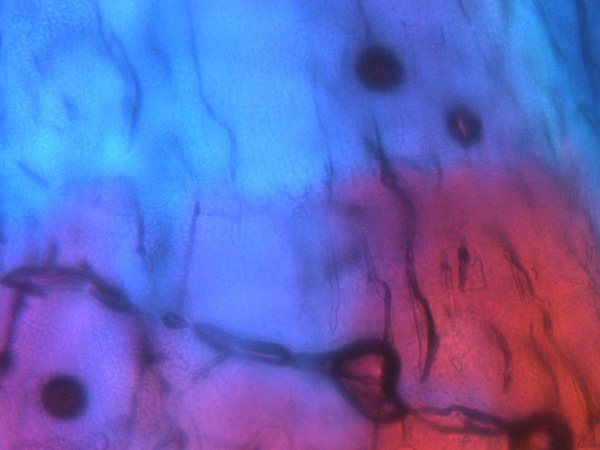
Alessandro Puccia, Ecuador | 2768, 2026, microscopic photograph of a frozen water droplet, dye- sublimation print on canvas, 130 × 180 cm, unique piece (1/1), courtesy of 89 Art Gallery.
In Alessandro Puccia’s photographs, water is never just what it seems. It is both what holds on and what slips away; what preserves a trace and dissolves it in the very same instant. Every element seems suspended in an intermediate state, as though it already belongs to another form: surfaces, reflections and transitions. Photography thus becomes a transitional space, a place where matter observes itself changing.
The neuroaesthetic experience is therefore not understood as passive contemplation, but as a transformative force capable of destabilising and recalibrating perception, 'infecting' it in a positive sense and displacing the observer from established cognitive frameworks. This has led to a need to rethink the role of architecture as a practice that can create conditions for coexistence and foster
community and shared spaces that preserve a 'fertile' quality of life. In such spaces, design does not exhaust the environment's generative capacity, but allows it to endure.
However, this perspective must consider water's inherent vulnerability. Its chemical composition changes in response to its surroundings, making it particularly susceptible to emerging contaminants. Microplastics, PFAS and other such substances act in ways that are often invisible yet far-reaching, thereby redefining water quality and consequently the quality of the human experience. In a time of widespread scarcity, it is crucial to shift the focus from availability to quality. Water is essential not only to biological survival, but also to the possibility of building shared futures.
One Drop belongs to a curatorial approach that uses water as a lens through which to examine the complex intersection between perception, ecology, and design. This opens up a field of enquiry in which water is an active subject, not an object. Through its inherently fluid and relational nature, water challenges every attempt to definitively fix the forms of contemporary life. In this exchange, One Drop reveals itself less as a collection of images and more as a process — something that does not end with the act of seeing, but continues in the thoughts it generates.
'In this context, a drop is not a minor detail; it is the starting point for a new beginning.'
International Galleries, Innovative Projects and Emerging Talent: