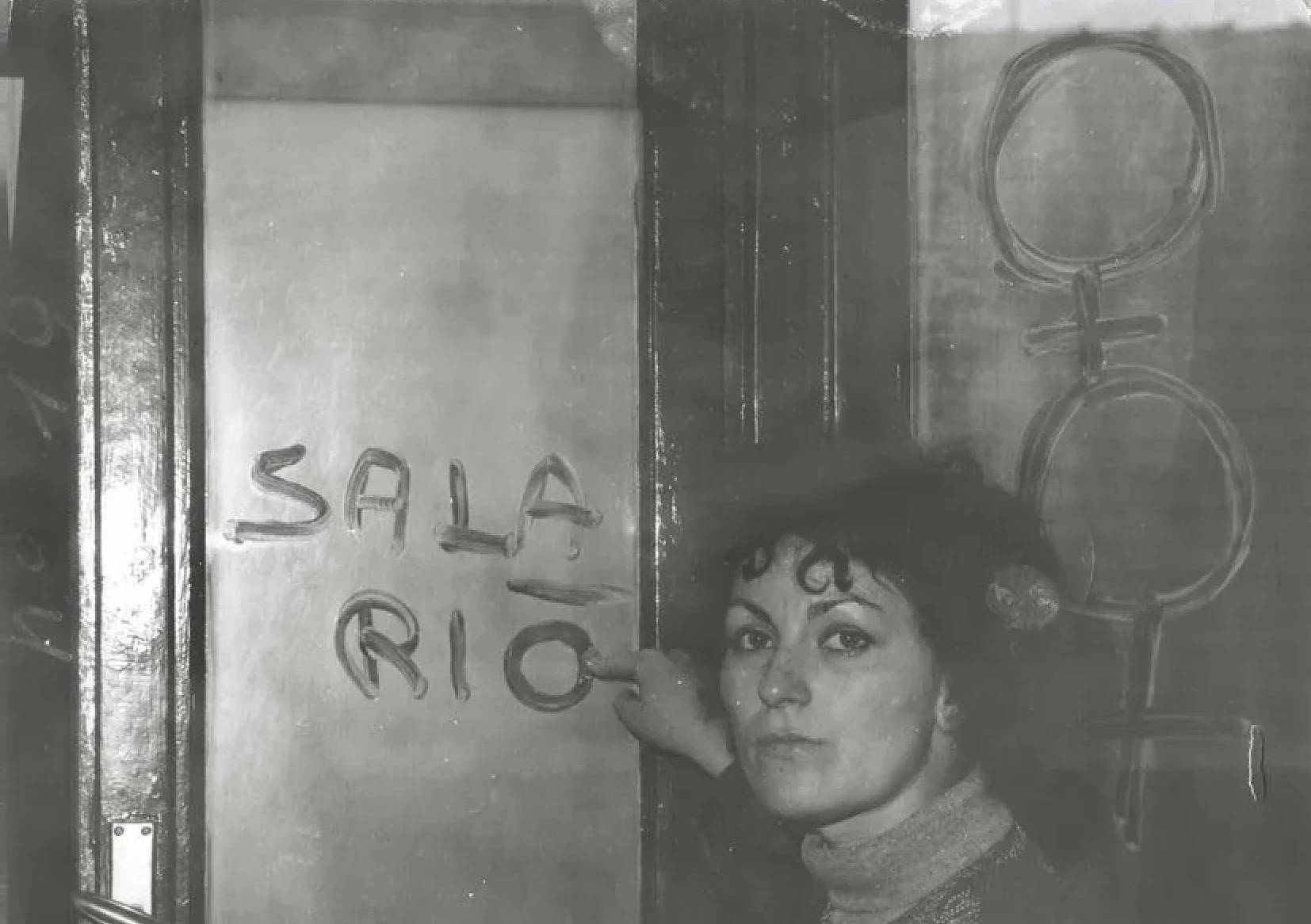
Milli Gandini, 'Wages for Housework', 1975. Performance using household dust and photographic series.
Visionary, disobedient, feminist. Milli Gandini (Varese, 1941 – Castiglione Olona, 2017) was an artist and cultural agitator who demonstrated a remarkable critical awareness of her home city: Varese in the 1970s was suffocated by the grey pall of neo-fascist resurgence, which sought to silence all forms of dissent.
Her approach was uncompromising, leaving no room for mediation: "Strike hard to rid the centre of Varese of the red scoundrels". From party secretary Francesco Guerrieri's leadership until 1971, through commissioner Osvaldo Magnaghi's period, up to the eve of the 1972 general election and culminating in Luigi Bombaglio's emergence, the Italian Social Movement–National Right (MSI-DN) presented itself solely through violence.
Steeped in far-right ideologies, Varese was part of the so-called black triangle, alongside Brescia and Milan. Yet these were also the years in which Fabrizio De André gave a voice to the marginalised, the rebels and those who refused to bow down with Non al denaro, non all’amore, né al cielo (1971). At the time, dissent was not just an act of courage, but an urgent necessity.
Artists such as Milli Gandini grasped this profoundly, transforming their work into a manifesto of resistance. Her 1975 work Wages for Housework—as irreverent as it was groundbreaking— exposed the hypocrisies of her time, portraying women beyond stereotypes and outside the confines of imposed rules.
But what connects dust to neo-fascism? Fifty years have passed since the artist's performance was captured in a series of black-and-white photographs, yet her struggle remains relevant. The urgency of feminist demands has not faded; they continue to challenge us and demand answers.
The Immagine Feminist Group
In this spirit, an audacious, militant collective emerged in 1974. “We cannot remember if it was a sunny or rainy day when we founded the Immagine Feminist Group of Varese with Mirella Tognola, but it was certainly a happy moment,” the founders recall.
IMMAGINE DA CAMBIARE A photograph of the Immagine Group of Varese. From left to right: Mariuccia Secol, Silvia Cibaldi, and Clemen Parrocchetti. Standing, from left: Mariagrazia Sironi and Milli Gandini.
At a time when art was considered an unsuitable pursuit for women — it was widely believed that they lacked the seriousness required for artistic work and should regard it as little more than a hobby — Milli met Mariuccia Secol and other activists with whom she collaborated. Furthermore, during the 1970s, women were generally expected to remain at home and devote themselves to housework, cooking, and childcare. Against this backdrop, Milli Gandini was often remembered solely as the wife of the designer Innocente Gandini (Legnano, 1941– Varese, 2016), which reduced her identity and talent to a mere attribute of her husband.
The Aesthetics of Rebellion And yet, the artist’s aesthetic did not go unnoticed. She sported a rebellious hairstyle reminiscent of Angela Davis', wore African garments and had once considered a life in a convent. However, sensing the restrictions of that environment in advance, she chose instead to fight for the freedom she knew she deserved. Her way of being and living reveals a deeply revolutionary attitude. Faithful to her ideals, she firmly believed that art was a powerful instrument of emancipation and social transformation. To her, women’s creativity was not just a pastime, but a weapon of resistance and a subversive gesture capable of shaking the world. Through her artistic exploration, Milli Gandini preempts the iconic line from the 2020 documentary The Social Dilemma: 'If you’re not paying for the product, then you are the product.' Through her provocative approach, the artist invites us to reflect on power dynamics and social injustices. She
asks why domestic labour goes unpaid, and highlights the need to develop a critical awareness of how we spend our time.
This form of feminist activism represents a cultural and political response to the surrounding neo- fascist climate, proposing an alternative, progressive vision of women’s role in society. Today, some things have changed, but there is still a long way to go. In 2025, with right-wing forces dominating much of the planet, what do we have left if not art? The real hope is that the little old ladies of the future will no longer sport neat little buns, but instead have rebellious manes brimming with healthy revolutionary anger. Manes that scream to the world, 'I refuse to accept things as they are.'