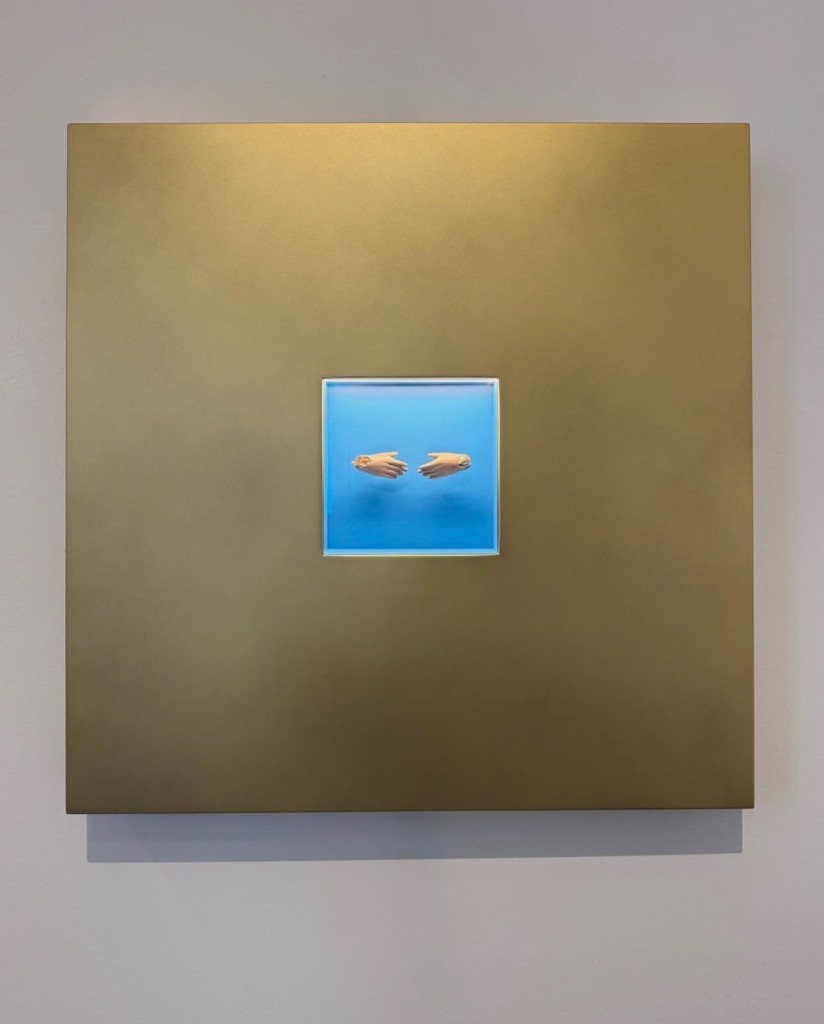
Serena Giorgi, Giulio Perfetti, Imagined Space, 2026: lacquered wooden structure with an illuminated display case cont aining small antique wooden hands (70 × 70 × 8 cm).
From 13 March to 16 April 2026, curator Silvia Franceschi will present an intimate dialogue among sixteen artists across the spaces of The Kitchen Art Gallery and Spazio Blue Train. The group exhibition Unknown Recipient brings together photography, cyanotypes, video, drawings and artists’ books, unfolding like a book waiting to be slowly browsed page by page. It invites visitors to slow down, look closely, and allow themselves to be moved by the images and stories on dis play. Visitors will feel naturally inclined to move around the exhibition with the same ease as in their own home. One of the exhibition’s most compelling aspects is its rhythm. In an age dominated by speed and the overproduction of images, 'Unknown Recipient' invites us to pause. The exhibition route does not impose a specific direction, but leaves room for exploratio n and curiosity. Visitors are free to linger over a detail, retrace their steps, or change their viewpoint. In this way, the exhibition becomes a space for attention and reflection, where the time devoted to observation seems to expand. Silvia Franceschi's curatorial approach is therefore subtle, avoiding the imposition of a single, definitive interpretation. Instead, she creates a field of possibilities, a space in which the works can encounter one another and generate new connections. T he dialogue between the
artists is never forced; it emerges gradually through formal similarities, shared themes or simple visual juxtapositions. The exhibition unfolds as a journey whose beginning and end are difficult to identify. Instead, it takes the form of an endless, circular journey, evolving through the use of various artistic languages. It is an experience through which to move, and which allows itself to move through us in turn. Bringing together different media contributes to the creation of a visual fabric that is both complex and intimate. Photographs capture fragments of reality and memory, while cyanotypes introduce a more material and experimental dimension built around impr essions, traces and layers. Videos open a window onto time, movement and storytelling, while drawings and artists' books invite a more intimate, domestic form of engagement. Together, these forms of expression construct a visual landscape oscillating betwe en personal narrative and collective reflection. These records affirm one thing: 'We are still alive'.
In Imagined Space, Serena Giorgi and Giulio Perfetti explore the sacred and the sensitivity of handcraft, bringing them to the centre of the discussion. The fragments of a statue, discovered by chance at a flea market in Barcelona, become the seeds of an entire imaginary world. Though broken, they continue to generate space because the only truly authentic space is that which the mind is capable of imagining. In Unknown Recipient, the relationship with the venue also plays a fundamental role. The interiors of The Kitchen Art Gallery and Spazio Blue Train create a welcoming, domestic atmosphere. Visitors do not feel as though they are entering a distant, institutional space, but rather an inhabited place where the works engage in dialogue with one another and with observers. Moving through the exhibition thus feels natural and spontaneous, much like wandering through the rooms of a familiar home. This sense of familiarity does not diminish the power of the works; quite the contrary, it amplifies their emotional impact. Many of the pieces on display appear to stem from small, everyday actions: collecting an image, jotting down a thought or noticing a detail. These practices evoke a personal, everyday dimension and are therefore capable of speaking to everyone. Together, the works form a constellation of intertwining stories, memories and visions that never entirely overlap.
Yet the exhibition’s title, which alludes to the celebrated work by American author Katherine Kressmann Taylor, immediately suggests an underlying tension: that between communication and uncertainty over who will receive the message. Writing, sending and leaving traces are actions that always imply a recipient, whether real or imagined. In this exhibition, however, the recipient remains undefined and suspended. The works inhabit this space of anticipation, questioning the relationship between artist, artwork, and audience. Viewers are invited to become active participants in this process by writing a note and placing it in a letterbox. These messages will subsequently be compiled into an artists' book, which will be published at the end of the exhibition.
In this sense, 'Unknown Recipient' also reflects on the nature of contemporary art itself. The works offer no immediate answers, but raise questions. To whom are they addressed? What message do they carry? And, above all, what happens when someone truly stops to listen? At a time of fragility, tension and uncertainty, the exhibition suggests that art can serve as a space for reflection and resistance. Rather than offering solutions to the problems of the present, it provides a space in which to imagine new ways of looking at and thinking about the world. 'Unknown Recipient' reminds us that every artwork is ultimately an open letter. A letter that travels through time and space, never knowing who will read it. Yet it is precisely this uncertainty that gives the letter its strength — the possibility that, sooner or later, someone will recognise themselves in the images, marks and stories. For a moment, they will feel as though they are the true recipient of the message.