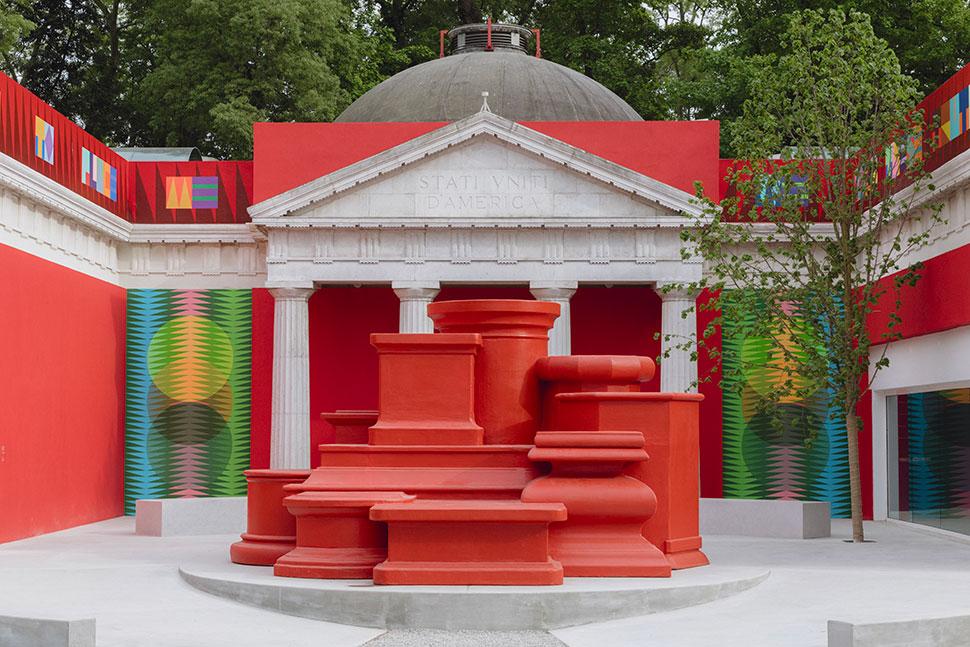
United States Pavilion, Venice Biennale 2024. Works by Jeffrey Gibson. Does the title 'Stranieri ovunque' (Foreigners Everywhere) truly reflect the work of the Claire Fontaine collective? Is it an appropriate title for this Venice Biennale edition? Imagine attending one of Italy's most significant cultural events and feeling taken aback not by the artistic power of the works, but by the sense that you have somehow ended up at Disneyland rather than the Venice Biennale. The dreariness, the disorientat ion, the vivid red confronting you and the exhibition design that inevitably brings IKEA to mind all seem deliberate. Palladio is probably turning in his grave.

We find ourselves in the United States Pavilion, which has been transformed into a jumble of insignificant trinkets. The works of Jeffrey Gibson (Colorado Springs, 1972), the artist representing the pavilion, appear unable to fully convey the history of trauma associated with colonisation and the experience of being a foreigner. Instead, they appear to celebrate bright, joyful colours, creating a jarring effect through their chromatic excess. While the political dimension of Gibson’s work is undeniable, questions remain about its effectiveness. Although his work combines queer ideals with his Cherokee and Choctaw heritage, making him the first Indigenous American artist to represent the United States at the Venice Biennale, these themes may have required a more serious approach. In an exhibition context such as this, lightness may not have been the most appropriate choice.
Jeffrey Gibson, The Space in Which to Place Me, United States Pavilion, Venice Biennal e 2024. Taking a broader look at the 60th International Art Exhibition, it is clear that the original intention of the curator has been lost along the way. 'Foreigners Everywhere?' Those expecting something revolutionary were unfortunately left disappointed by the lack of substance. The exhibition project at the United States Pavilion was a missed opportunity, offering only a superficial and incoherent outcome that lacked the depth and radicalism expected from such a significant event in a country with such considerable power.
One of the main issues is the excessive use of interactive installations, which ultimately take precedence over the artistic content, offering an experience that feels more like a special-effects show than a critical reflection. Technology is used in a superficial and spectacular way, reducing complex
themes such as the environmental crisis and social inequalities to mere aesthetic devices. The works on display seem more concerned with astonishing viewers with eye-catching visuals than fostering a deeper understanding of the issues at stake. Conceptually, the pavilion feels disjointed and fragmented. The participating artists appear unable to establish a shared language or unifying theme to bring their works together into a coherent whole. The end result is a disparate collection of pieces that, despite attempting to address major issues, fail to engage in meaningful dialogue with each other. This lack of cohesion makes the overall experience disorientating, leaving visitors with the impression that the key messages are lost amid formal chaos devoid of clear direction. The works lack originality, as they predictably revisit themes that have already been extensively explored by other artists in different contexts. They offer no genuine critical reflection or innovative proposal for how art could effectively raise awareness or inspire action. Furthermore, the approach to social justice and racial issues seems merely decorative; these concerns are only superficially addressed through works that fail to move beyond empty, conventional symbolism. The pavilion seems trapped within a paternalistic and self-referential vision in which the United States places itself at the centre of the global discourse, without questioning its own role in the crises it seeks to address. There is no decisive act of self-criticism or meaningful reflection on how the country could actively contribute to transforming the dynamics it has helped create. The narrative on display seems more concerned with preserving the image of a progressive, socially conscious nation than engaging in genuine self-examination.
Disobedience Archive : A project that restores hope.
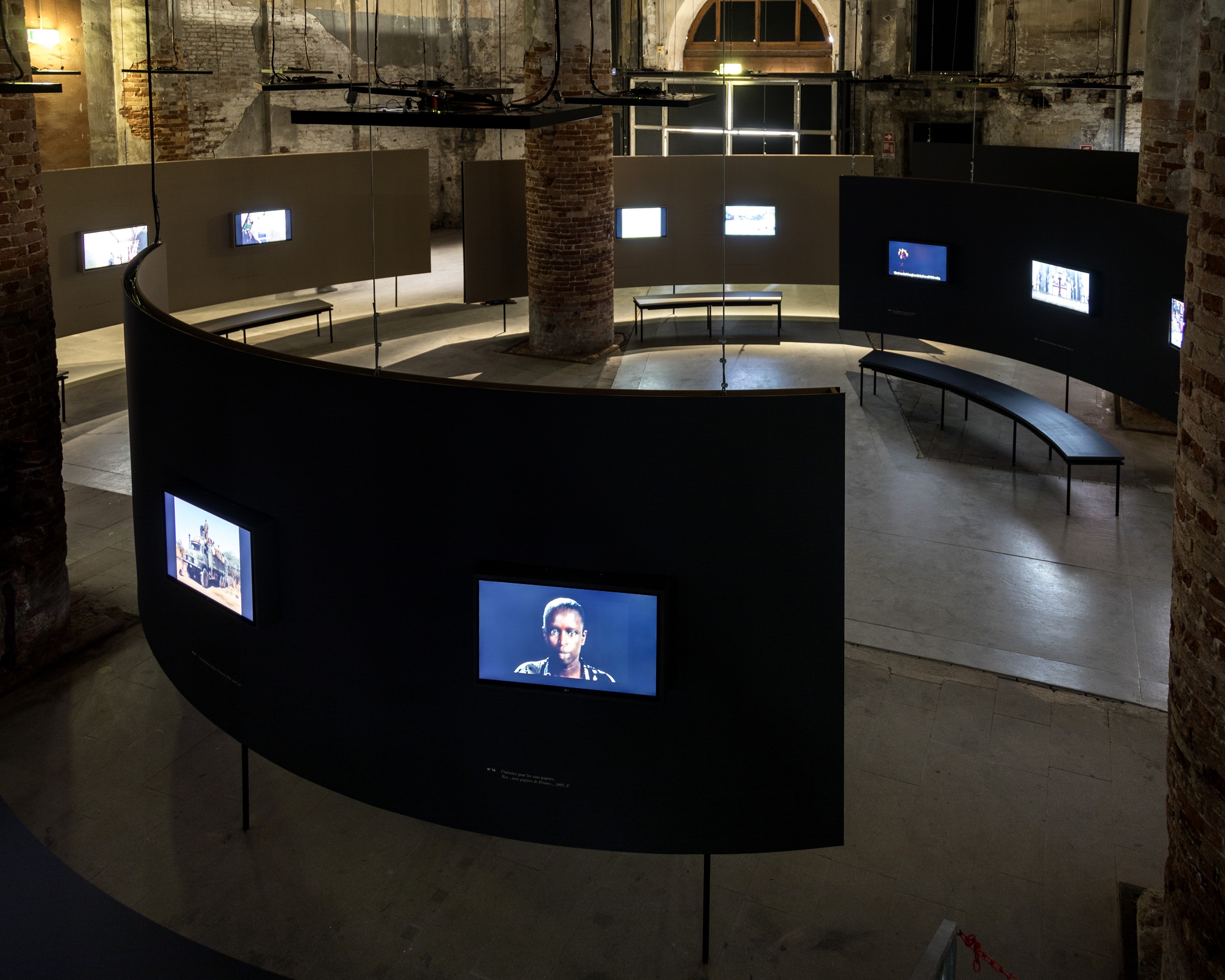
Fortunately, some projects, such as Disobedience Archive curated by Marco Scotini, managed to restore expectations for the Biennale. This documentary research project explores the relationship between civil disobedience, artistic practices, and political movements. Conceived in 2005, the archive is a constantly evolving platform examining acts of resistance, social struggles, and grassroots activism. It brings together videos, documentaries, interviews and a wide range of materials that document various forms of disobedience, including political, cultural, artistic and ecological practices. The project's main objective is to trace the visual history of protest and dissent that often remains outside the scope of official dissemination channels.
Disobedience Archive, curated by Marco Scotini. Installation view at the Venice Biennale, 2024.
The project involves several artists, the most notable of whom is Želimir Žilnik. He uses his camera to cross borders in support of, and in solidarity with, liberation struggles. His films made a significant contribution to the Yugoslav Black Wave of the 1960s and 1970s. During this period, Žilnik focused on important issues such as inequality, political tensions, and social change. The filmmaker documents the lives of immigrant workers in West Germany whose stories are often marginalised or overlooked. He seeks to take stock of their experiences and living conditions within a complex industrial landscape. The project also features female artists, such as Daniela Ortiz, who uses puppetry to tell the story of forced migration, one of the many consequences of colonialism. The performance's protagonist, Mooki, is deprived of the resources necessary to make a living in his own country and is therefore forced to leave for Europe in search of a better life. Disobedience Archive places particular emphasis on global movements that have challenged state power, dominant institutions and the capitalist system since the 1960s. The featured movements range from the 1968 protests and the early 2000s anti-globalisation demonstrations to more recent mobilisations in defence of the environment and human rights. The project serves as both a documentary resource and a platform for critical speculation. By engaging with the archive, viewers are encouraged to consider power dynamics, the function of art as a means of protest, and how forms of resistance have changed over time.
“Disobedience Archive is a landmark in artistic and political research, preserving the memory of historical struggles for emancipation.” A Faltering Edition In summary, Disobedience Archive is a landmark in artistic and political research. It helps to preserve the historical memory of struggles for emancipation, while encouraging critical reflection on the present and future possibilities of disobedience. However, the 60th International Art Exhibition, curated by Adriano Pedrosa, proves to be on shaky ground. Visitors are confronted with what appears to be an accumulation of 'things', while some works seem better suited to the contemporary art scene. While the initial intention was to revisit the concepts of the outsider and marginality, not all curatorial choices succeed in challenging the exhibition's ability to generate new artistic narratives. The 60th International Art Exhibition was ambitious in conception, aspiring to advance the discourse on decolonisation. Nevertheless, it also exposed the limitations and contradictions of an event attempting to address global issues while remaining within the confines of an established institutional framework. Ultimately, the result is a potentially troubling reinforcement of the perceived cultural and ideological distance between the West and the Global South. Overall, the Venice Biennale proves to be less revolutionary than promised. What a shame.